

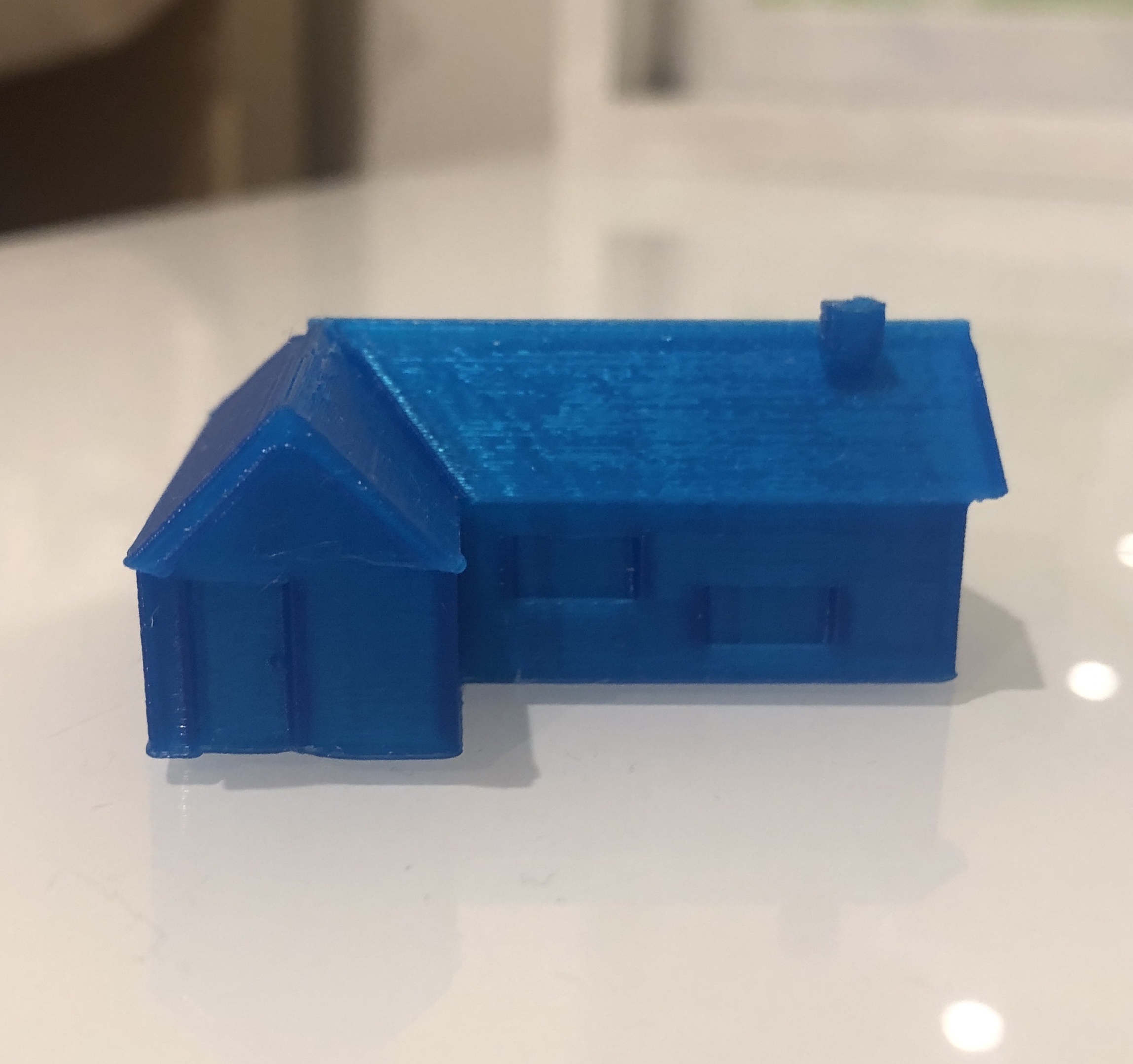
This week in tutorials we explored the wonders of 3D printing. We had a chance to step into the shoes of students and learn how to navigate our way through the program SketchUp and watch our ideas come to life! Now don’t get me wrong, it was hard! But completely do-able with a bit of practice! Having spent a small amount of time exploring the program in class and at home I am confident that I would be capable of creating some awesome tasks for my students to create and design 3D objects. Above is an image of my design on SketchUp and below if the 3D version which was kindly printed out by my tutor, David.
Berry et al (2010) suggests that 3D printing and design facilitates learning, advances skills, improves motivation and engagement, inspires creativity and develops interest in STEM subjects and possible future career options. Ultimately a teacher will foster the highest potential for creativity when developing a project-based task. Here students engage in problem solving, by completing the entire design cycle beginning with creation and concluding with a physical model. (Ford & Minshall, 2019). 3D design allows for self-directed construction, experimentation and opportunities for student reflection and observation. (Eisenberg, 2013). Published research provides countless examples of 3D printing class projects including prosthetic hand designs, bridge structures, desk lamps and many more. (Ford & Minshall, 2019).
I have chosen some additional examples that I believe have the highest potential to foster creativity. My first example is creating a musical instrument. (Ford & Minshall, 2019). This task could be presented to students from a range of ages and abilities. Depending on the criteria provided, students could work individually or collaboratively to design a unique instrument with a number of qualities. If I were the teacher I would ask students to design a new instrument that has at least 2 sound functions. Another project could involve students designing and planning the characteristics of a city. This city would be set in the future and students can design it however they like, as long as they can provide reasoning to support their design.
References
Berry, R., Bull, G., Browning, C., Thomas, C., Starkweather, G., & Aylor, J. (2010). Use of Digital Fabrication to Incorporate Engineering Design Principles in Elementary Mathematics Education. Contemporary Issues In Technology And Teacher Education, 10(2).
Eisenberg, M. (2013). 3D printing for children: What to build next?. International Journal Of Child-Computer Interaction, 1(1), 7-13.
Ford, S., & Minshall, T. (2019). Invited review article: Where and how 3D printing is used in teaching and education. Additive Manufacturing, 25, 131-150.
 Exploring Digital Creativity In Education